why
Governments, lenders, and tenants raise the bar on how much carbon a building can emit. A building that falls behind becomes harder to lease, finance, or sell, and may need expensive upgrades. These financial consequences are known as transition risk: the cost of adapting to a low-carbon economy. But identifying that risk is only the starting point. The harder question is what to do about it.
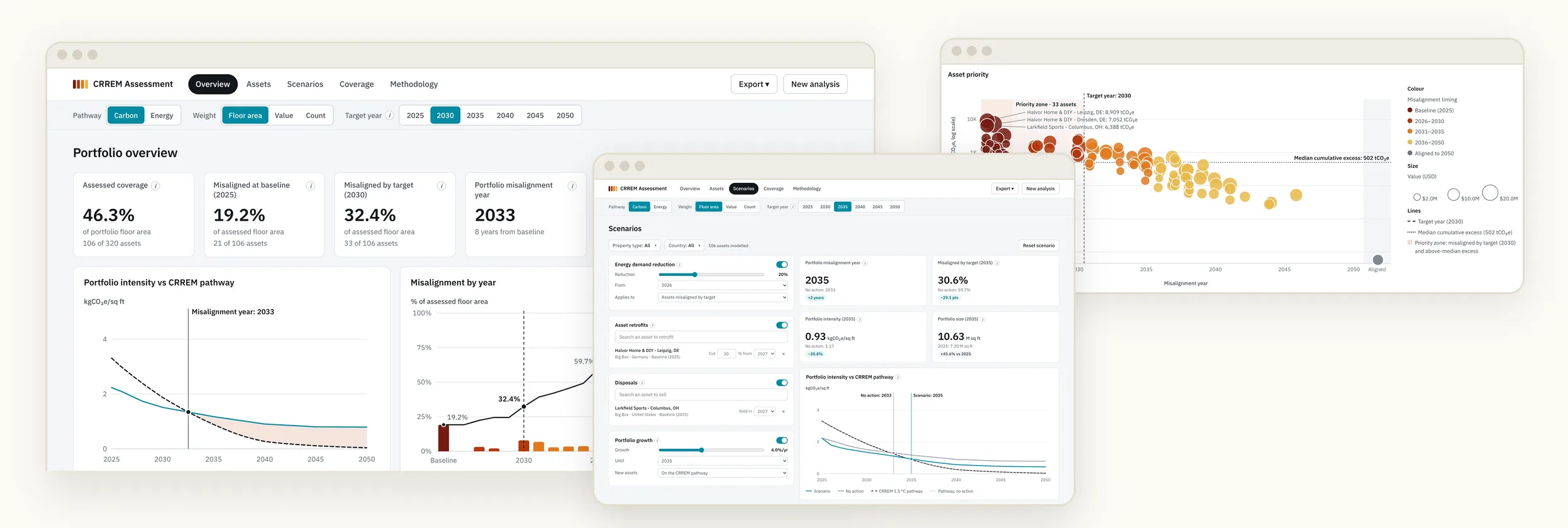
Investment and property managers need to understand where risk is concentrated, which assets deserve attention, and how different investment or operational decisions could change the outcome. I built this tool to turn climate-risk analysis into an interactive decision-making application.
how it works
- 01Upload. Load a property portfolio CSV. The tool validates inputs, checks data quality, and flags assets that cannot be reliably assessed.
- 02Assess. Each building’s carbon and energy use is measured against the reduction path, and performance is projected through 2050.
- 03Explore. Identify risk concentrations, prioritize buildings, and compare exposure across property types, location, floor area, or asset value.
- 04Simulate. Model energy reductions, retrofits, disposals, and portfolio growth to see how decisions change future performance.
design principles
ANALYTICAL MODELING
Prioritize cumulative impact. Rather than ranking buildings on carbon intensity alone, I calculate excess emissions over time to capture the size, severity, and duration of exposure.
PRODUCT THINKING
Make uncertainty visible. Assets with insufficient or unreliable data are explicitly flagged, so users can distinguish measured portfolio risk from gaps in assessment coverage.
SOFTWARE EVALUATION
Evaluate against a golden dataset. I validated the calculations against a golden dataset built from CRREM’s official worked examples, and added automated tests for analytical correctness, edge cases, and browser functionality, so users can trust the results.
SYSTEMS ARCHITECTURE
Privacy by design. I used Pyodide to run the Python engine directly in the browser, keeping sensitive portfolio data on the user’s device rather than uploading it to a server.
TECHNICAL JUDGMENT
Deterministic over generative. I chose a calculation-based engine rather than an LLM so that every result is reproducible and traceable to an established methodology.